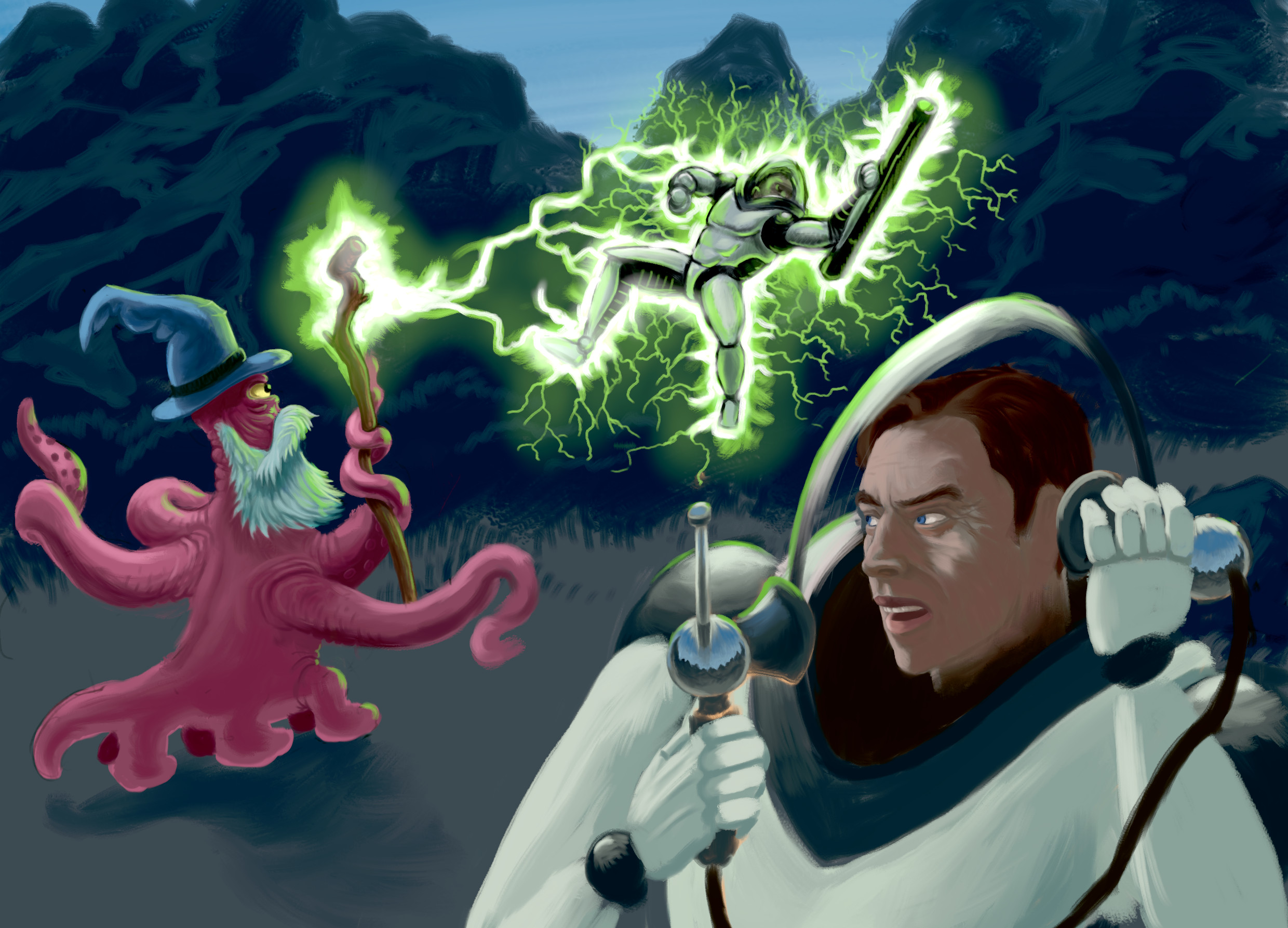
This could use a lot more polish, but I don’t think I’ll ever get around to it. Story of my life. 
That comm device is top notch 
2 Likes
Only the latest and greatest for my troopers! 
1 Like
Well done! I love the expression on the astronaut’s face.
1 Like
Thanks!
“Yes sir, there is life on this planet. It is extremely hostile!”
1 Like
It might be rough around the edges but it’s still pretty cool! 
Umm… did you finish your masquerade pic yet?! 

1 Like
Very shocking.
1 Like
@Mythmaker @Sineater Thanks!
Regarding the masquerade image… I guess the truth is that I’m not capable of making it much better yet. I’ve been tinkering with it, but it feels like I’m just making it worse.
1 Like
Okay - I was mostly joking anyway…
It’s possible I’ve tinkered with mine too! 
And you made it better?
I think that what I ought to do is follow the advice I got from Naloe and Kynlo about a year ago, use a few different reference images and try to combine them into one image. And do at least one of those every day. To build my visual library.
Well… It was a pretty rushed effort when I posted it so I’d hope so - but you can judge for yourself when I’ve finished noodling! 
The reference thing is a bit of a chicken and egg situation - I try to start ideation first so references are always subservient to my creative vision; but better ideas can often come from looking at references… 
So maybe start generating ideas, then do some research and gather references you find interesting - but put them away while you do some more ideation with what you’ve learnt. You should be able to get your broad idea down as a thumbnail before you need to draw on references for details.
There’s no hard rules you have to follow but I try not to let my references dictate my creative choices - I draw on them to help add realism and interesting flourishes.
That’s for illustrating a specific idea though - I’m not saying the suggested exercises wouldn’t be helpful.
1 Like
It’s really interesting to see how everyone is approaching this ‘problem’.
At the moment I feel I just want to get my speed up so that I can finish a painting before I get bored with it. To do that I think I need a decent library of references and understanding of them in my head instead of spending hours on Google’s image search to find just the right angle.
I wouldn’t worry about speed - that comes as a natural consequence of experience; Focus on doing things right and the speed will take care of itself.
Developing a good process is very helpful with speed and efficiency - and that’s where I’ve always struggled. I habitually rush into things, then have to spend an eternity trying to fix what I should have done earlier… 
1 Like
That is pretty close to what I’ve been doing for almost fourteen years now, without seeing much improvement or increase in speed. I don’t doubt it works for you, but for me… I have to change strategy. At least try another one.
1 Like
I don’t think we’re in disagreement though - I’m not saying what you’re intending to do is wrong; I’m only saying to be careful about mindset.
It’s just that if you go into study thinking you have to be fast to get faster it could have the opposite effect; For one you might not pay enough attention to get the benefit from your study, you are more likely to make mistakes, and may even reinforce existing bad habits.
There is also the issue of process; as I said I’ve always struggled with that. I’ve found that if I can solve composition and drawing problems before I start rendering, it makes the painting process much faster and more enjoyable. That way I don’t have to kill the expressive brushwork as I spend countless hours trying to fix things.
I don’t usually do that though - I rush into it and then have to fix it with brute force. That’s not quick and it’s not fun, and I’ve found it hard to finish anything as a consequence.
I’ve done pieces for contests in the past where I had to follow good process to participate - posting milestones as I went. That helped me produce art that still looks pretty impressive to me now in spite of years of progress.
Conversely, with something like my masquerade piece - I ended up rushing it, and while I’ve improved it, it’s taken a disproportionate effort, I haven’t really enjoyed it, and I still don’t love it! 
So… umm… I think there was point in there somewhere! 
Could you describe the milestones you had to do in the contests?
It’s a bit difficult to remember now - It was 15-16 years ago. 
I know I posted sketches at the ideation stage - such as character sketches. I also did rough colour thumbnails. I think the required stages were actually the lineart, then two or three painting stages. Interaction and feedback was encouraged.
A good process would be something along these lines:
- Research
- Ideation
- Thumbnails
- Reference gathering (could mean photographing your own)
- Value studies
- Colour studies
- Lineart
- Rendering
It might not be in a strict order - I tend to combine ideation with thumbnailing, which I paint like value studies. I might end up looking at references while researching.
That’s when I’m being good though - I’m usually naughty and jump to the last bit first!
Everyone is different though, and such a structured approach wont always be the best way - like if you’re going for a more organic flow-of-conscious style.
1 Like
Wow, that seems like a lot of work!
For important images I can understand the need for all of it. Especially if you need a customer to be pleased with the end result.
Yeah - it sounds offputting, especially when you just want to get into the juicy painting bit!
I did a fair bit of that when I was doing some of the CA weekly challenges - I used it as a focus to help me practice process. I actually found the research was really fun when you get into it - I could end up spending ages on Wikipedia reading stuff, and gathering cool looking photos to get the juices flowing.
Doing thumbnails can be very satisfying - I can get through a sheet of 8 mini paintings in a couple of hours; so the complete opposite to 10s of hours nooding all the intricate details on a full piece.
It also helps grown your visual library because you’re doing the study as part of the process.
If you can do a nice lineart and solve your drawing problems first - then the painting can be quicker and more expressive. It saves having to fix things when you’ve already rendered them which is huge pain in the butt!
So in the end it will probably be quicker, the result is likely to be more impressive and satisfying than what you could have achieved if you’d just painted it. Finally - you would have learnt more in the process!
Hmm… that actually sounds pretty good! - Think I should probably do that myself…
I don’t remember such requirements for the weekly challenges, but maybe I didn’t read the rules well enough.
I will try this for one of the monthly art contests here at KA though. See how it feels.
1 Like