Call for donation of artworks for the Fast Line Art project

Why do we need artworks?

Fast Line Art is using neural networks. They differ from the classical algorithms that use human-defined rules to do the task - they make up the rules themselves based on data, so they need data to train on. In the case of this particular network, it will need both sketches and line art – sketches as an example input, and line art as expected output. It needs quite a big amount of data – thankfully not as much as generative AI, but still, let’s say, several dozens.

The way it works is that the network takes the sketch, processes it and outputs a picture. Then our algorithm will compare the output picture with the expected line art, and the network will try to correct the errors. And that happens for all pictures many, many times over. For the network to work well, it needs to slowly accumulate small changes, and it needs varied input and output so it can work universally, and not just on one or two artworks or even artists.

If you are an artist that uses line art in your work, it will be a huge help if you can donate your time and work and draw a sketch and line art to be used in the training of the neural network.

For all the details about the project, please check out Introducing a New Project: Fast Line Art

License for your artworks

If you decide to participate, we ask you to license your work with this license:

Creative Commons Attribution License (CC-BY), with the requirement of attribution waived in the following specific circumstances:

  • The Licensed Material and its derivatives are used by Stichting Krita Foundation, located at Korte Assenstraat 11 7411JP Deventer, the Netherlands.
  • The Licensed Material and its derivatives are used by Halla Rempt Software, located at Korte Assenstraat 11 7411JP Deventer, the Netherlands.
  • The Adapted Material is a machine learning model trained on the Licensed Material, which was created and trained and developed only by either Stitching Krita Foundation or Halla Rempt Software or both.
  • The Adapted Material is an image that is a derivative of the Licensed Material that was created using a machine learning model trained on Licensed Material, where the machine learning model was created and trained and developed only by either Stichting Krita Foundation or Halla Rempt Software or both.
  • The Adapted Material is a machine learning model licensed with GPL license.

Let’s call the license “CC-BY-KRITA-FLA” from now on.


Submissions

The neural network will learn easier and faster, if our dataset is as close to its task as possible.

  1. We strongly suggest creating a new dedicated artwork instead of donating some of your older work, because of all the rules below.

  2. You have to have all rights for the artwork (must be drawn by you, it cannot be a fanart, it shouldn’t be anything done for clients or using other people’s property, or based on a photo you don’t have rights to etc.).

  3. The artworks must be licensed as in the section above (“CC-BY-KRITA-FLA”).

  4. You need to submit artworks paired: sketch and lineart for the same picture.

  5. The artworks must be submitted in PNG or KRA formats, and should be at least A4 300 dpi (2480 x 3508), but preferably A3 300 dpi (3508 x 4960) or more. (But note the brush sizes requirements). Both artworks needs to be the exact same size (best to just draw one on top of the other in the same document and save both to PNG the same way).

  6. The sketch can be drawn with any reasonable brush with a reasonable size (in comparison to the lineart thickness - it doesn’t have to match exactly, but it has to be reasonable).

  7. The sketch must be done in dark color over a white canvas. The sketch must be digital.

  8. The lineart must be done on white canvas using black color with 100% opacity.

  9. There are only a few brushes and brush sizes to choose from:

  • “b) Basic-1” at 12 px

  • “b) Basic-5 Size” at 12 px or 20 px

  • “h) Charcoal Pencil Medium” at 12 px

  1. When submitting the artwork, provide this information:
  • Name: your name or nickname for credit

  • Brush: which brush and brush size did you use in the lineart (separately for every line art piece if you submit more than one)

  • License: copy the license from the section above (CC-BY-KRITA-FLA).

  1. Sketch:
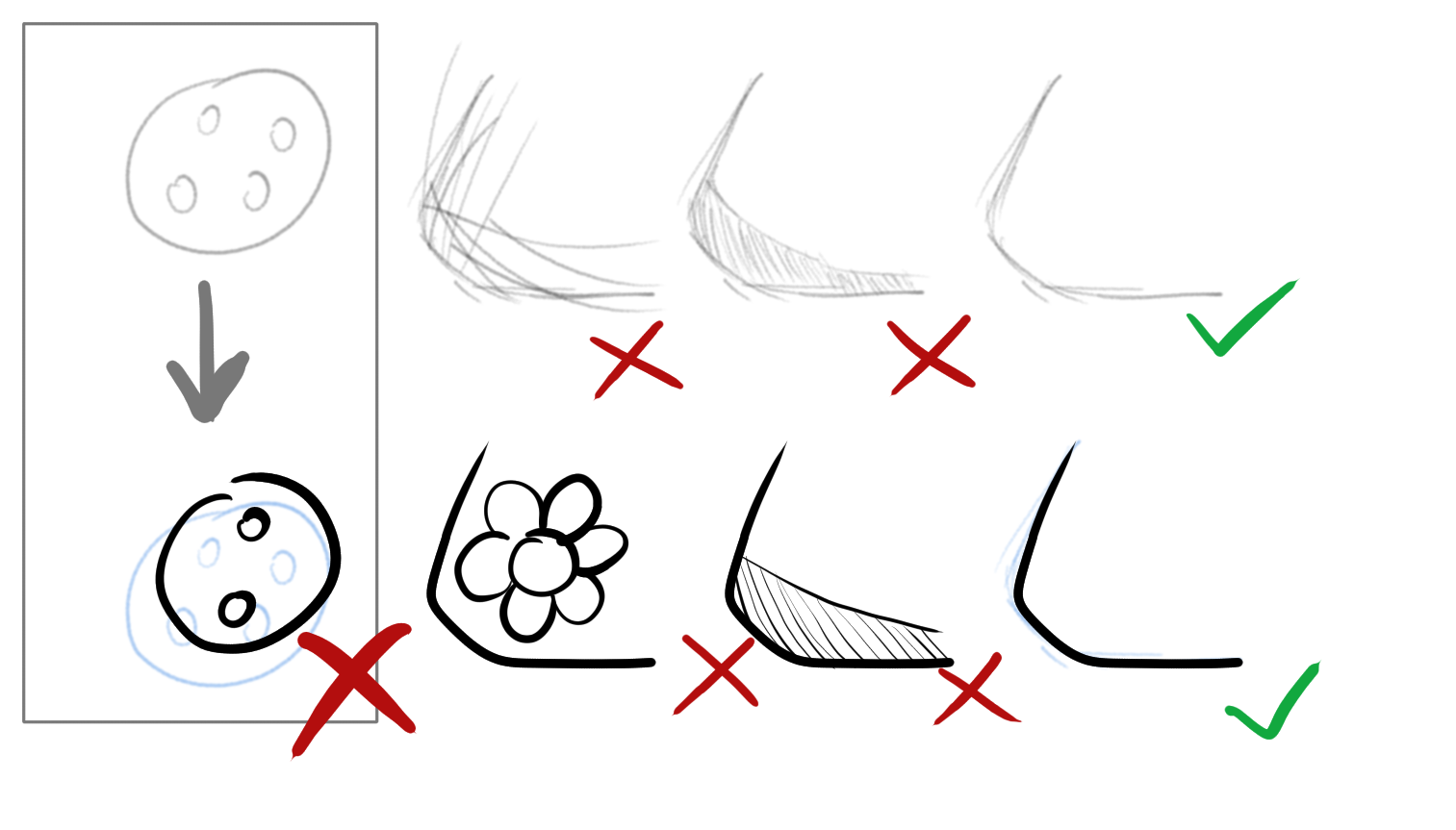
  • no cross-hatching or shading,
  • all the lines that don’t end up in a lineart (like construction lines etc.) should be lighter,
  • perspective, composition, anatomy etc. in the picture don’t matter. What matters is whether the line art looks nice and fits the sketch.
  1. Line art:
  • same size as the sketch,

  • no cross-hatching or shading,

  • no additional details that weren’t included in the sketch,

  • very closely following the sketch. Imagine traditional inking over a pencil sketch: the sketch usually already has all the details, and you’re only following the lines with a pen to make them permanent and nice looking.

  • If you draw typical anime eyes (thick eyelashes line etc.), it’s actually probably better if you don’t include them in either the sketch or the lineart, since it will throw the neural network off. Likewise for all other details that look very different from the sketch, or need to have a special case.
  1. How to submit:
  • You can submit here in this thread - please add a note in your comment that you submit under the license written above (CC-BY-KRITA-FLA).
  • You can send an email to foundation@krita.org - please add a note in the email that you submit the artworks under the license written above (CC-BY-KRITA-FLA).

If you have any questions about submissions or the artworks etc., please ask them here and I’ll try my best to answer. If you have questions or comments about the project itself, please check out the other, general thread: Introducing a New Project: Fast Line Art

Thank you very much for your support, I really appreciate it.
15 Likes

Hey, nice to see the effort starting! It’s helpful that the requirements are clearly explained, with picture examples.

The license terms also make sense to me. I’m guessing it is to ensure that a sketch inked with this method won’t require the attribution of artists who donated to the data set.

I have a question – will it be helpful to also provide more “generic” images, such as geometric shapes, doodles, etc. as long as the sketch has a nice variety of lines in it? Or is it preferred to submit actual artworks, depicting something that an artist would draw, like a full background, or a character?

(I’m keeping in mind the note about perspective/anatomy not being important).

Yes, though an important part is interactions between lines, which are less likely with simple drawings. But yeah. The picture doesn’t have to even show anything specific. Can be practice pieces, based on some CC-0 photo etc. It’s more important that the line work itself is looking good.

2 Likes

One question about the drawing:

If I am choosing A4 or A3 and do multiple sketches in that document. For example multiple flower sketches and their lineart. Is that ok or should I separate them?

Is this part of the recognised processes of the Creative Commons organisation?
Can you conditionally override the BY requirements of a formal CC license by creating a new type of CC license?

Submitted under the CC-BY-KRITA-FLA licence
Name: BeARToys
Sketch: “h) Charcoal Pencil Medium” at 12 px
Lineart: “b) Basic-5 Size” at 20 px
Size: A3 300 DPI


6 Likes

Hey, I think we need clearer upload instructions. What @BeARToys submitted got converted to a JPEG and scaled down. This is normal, the forum tries to compensate for large uploads.

Should we have a common hosting platform? Like Google Drive or similar? Or should everyone self-host and only post links?

I think we would also benefit from a standardized naming scheme. E.g. include brush in the file name or something.

Ah ok. I will send it per email.

I think it’s still cool to post previews here! That way we can get feedback from Tiar or get inspired :smiley:

3 Likes

I have seen a few ones in the past, they’re usually generally called “modified Creative Commons license” (often restricing use from religious, polical or general advertising) therefore I assumed this to be okay but I never really questioned if it’s actually is allowed.

https://wiki.creativecommons.org/wiki/Modifying_the_CC_licenses

So, it seems it is allowed but you then are not allowed to use the CC branding (icons and stuff) or call it Creative Commons so it looks like an official CC licence.

However there are exceptions like when restrictions are removed under certain circumstances.

It is permissible, however, to impose terms of use that have the effect of increasing (or removing the conditions on) the permissions granted to the public under the standard terms, such as waiving the attribution condition or allowing translations of an ND-licensed work (see CC+)

I think that’s the case here since the modification removes the BY requirement for Krita and the foundation when used for the model.

2 Likes

If artists could train themselves, that would be great. For example, I already have dozens of sketches and line art, all of which I independently completed. If I use them for training, the training results will be closer to my own style. I believe that even for line art, each artist’s drawing method is more or less different. If a window for artists to train themselves could be opened in the future, it would be very good. Of course, pre trained results are also necessary, which can allow artists to quickly experience this function. Moreover, in some painting styles, line art is only an auxiliary, and the effect of line art on the final work is very small or even non-existent. I am looking forward to this function. Thank you!

2 Likes

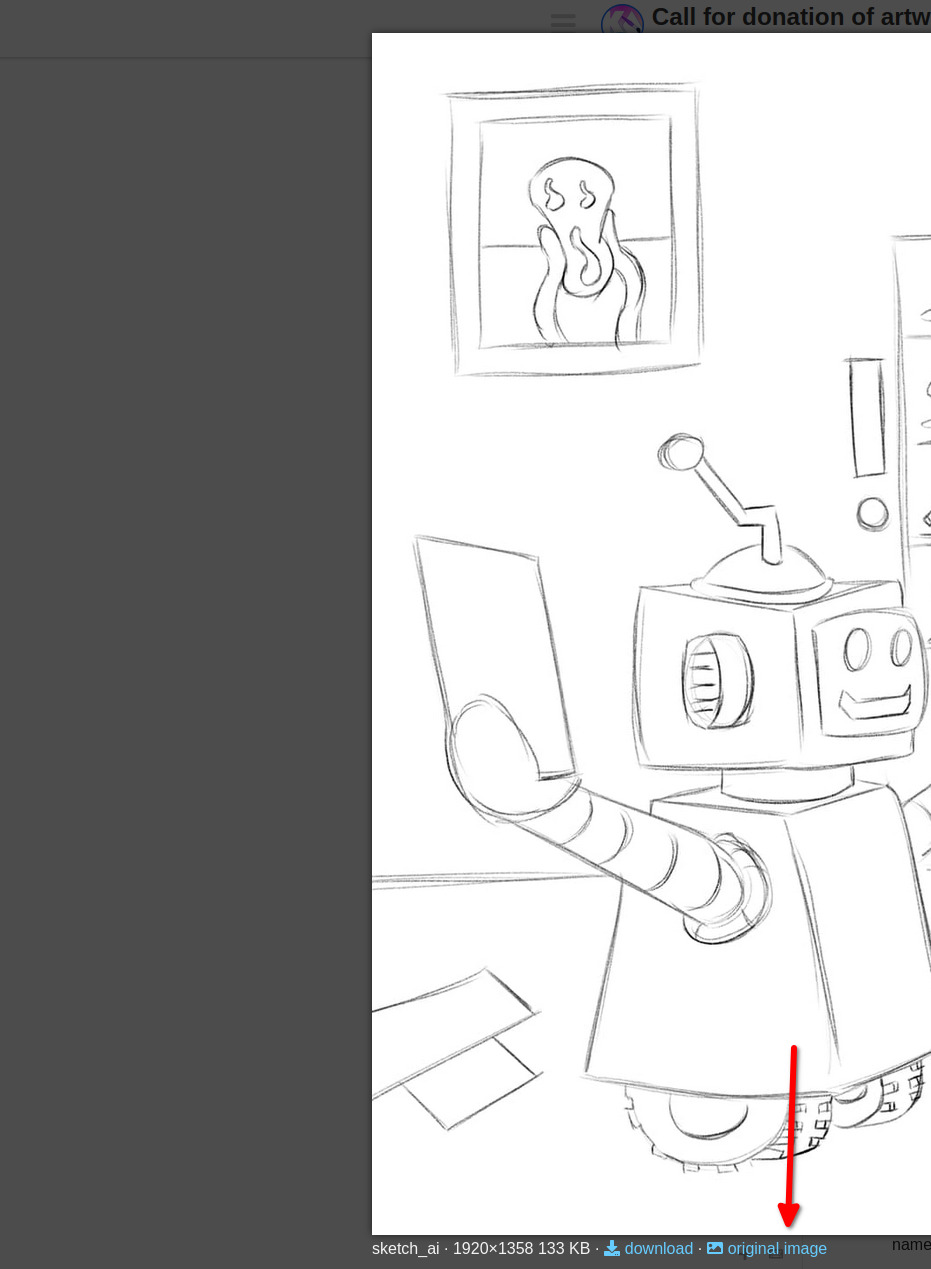
You can get the original image if you click on the images and click on the original image link at the bottom.

1 Like

I mean the resolution is much lower than stated in the requirements, so I assumed it got shrunk at some point.

aah there is a limit of 9 megapixel on forum so if it is higher then that it won’t accept it. I agree it will be best to send original files via email.

3 Likes

Personally, I feel that submissions should be done in the most transparent way possible to engender trust and community verification if you have made up your mind on proceeding in this direction. Otherwise, Krita risks operating like most unethical generative AI companies by obscuring their datasets with a “Trust us, bro.”

Some questions:

  • How does this submission framework verify the ownership of submitted artwork?

  • What measures are in place to detect and prevent fanart or third-party content submissions?

  • How does the submission process ensure compliance with the rules?

  • Are there digital fingerprinting or plagiarism detection tools used to identify unauthorized content?

  • How does the framework address the risk of dishonest contributors submitting unauthorized works?

  • What legal or contractual measures enforce compliance with submission rules?

  • Are there comprehensive guidelines for validating the originality and ownership of artwork?

  • How is ongoing monitoring or oversight of submissions conducted to ensure compliance after submission?

  • What are the consequences for submitting unauthorized works, and how are they enforced?

I’ll submit this, I hope I did it right… :thinking:


Sketch:

Line Art:

Sketch and Line Art combined:


Artwork made by Katamaheen
Used brushes: Sketch - Pencil Tilt - Size 70px / Lineart - b) Basic- 1 - Size 12px
License: (CC-BY-KRITA-FLA)

4 Likes

I don’t think, that pencil tilt is allowed :thinking: only the soft Charcoal pincil was listed.

There’s an interesting thing here: the sketch strokes are “clean”, it’s not really sketching.
The drawn over line art is exactly the same than sketch.

I’m not sure it’s something expected in artworks but it could be a good base and you have non totally black lines, to get a proper black line :thinking:

Grum999

Weren’t the listed brushes only for the line art?

It seemed to be that way for me, as the list went on to talk about the line art part, but I might have been wrong…

2 Likes