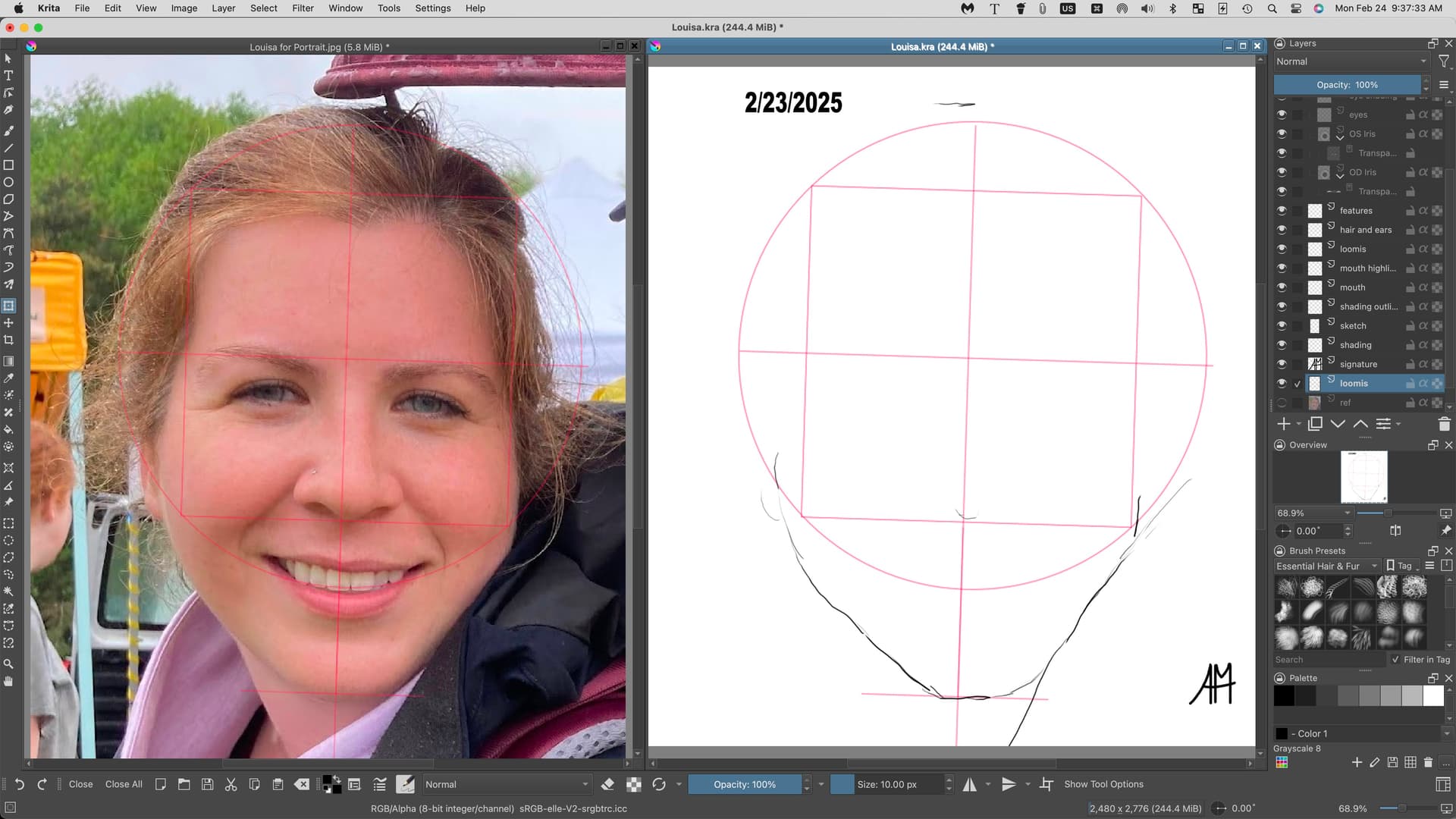
When you use a Loomis head for blocking out a drawing, do you first superimpose it on the reference image, as shown here? If not, how do you know whether your subject deviates from the usual proportions?
The reference image is my own (I own the copyright).
Probably we all have our own methods - here’s mine.
I use the Loomis head method only when I’m drawing from imagination. If I have a photo as reference, I pick a feature on the face and work everything off of that first feature. For example, your reference has lovely eyes that angle downward on the outer edges. That feature is so distinctive, I would build everything off of them using the distance between them and the distance between the outer edge of the eye and the hairline, etc.
As you are probably aware Piano Al, we are not all made the same.
I would not use the Loomis head in this instance and instead transfer the proportions of your female subject onto the canvas. How you do that is entirely up to you. you can use a few marks like sooz suggests or as many as you wish.
I don’t trust these methods 100% because the current reality is different. In drawing school I learned that the ear is almost the size of a nose. However, I noticed that many people’s ears were much smaller than their noses…
When drawing from life, you observe the subject and transfer what you see onto your substrate. You do the same with a reference image if your intention is to replicate what you see.
Exactly… but then this method ends up getting lost. The problem is getting too attached to a single method. Loomis himself showed that the shape of the skull varies, as shown on these pages.
Thanks. Yeah, I agree with you guys. Here’s my current system: first, I try to draw it freehand. That doesn’t work very well, so I delete that layer and use the grid with a big grid. Then I use the underlaid reference to correct any problems, and then I either render or start again with a new reference.
Hopefully, this system will help me get better at freehand.