I get very hesitant when inking on top of it, regardless if it’s done digital or traditional. I am fairly confident or at least, getting better with confidence, doing very basic pencil sketches. But when it comes to cleaning up and inking, I feel like because of the permanence of ink that I may “ruin” a perfectly good drawing and should be careful as possible. Does anyone else deal with or previously have dealt with it and how did you fix this unproductive mentality?
Do it. Every artist has to struggle with inking. The only way to forget this is to ink and ink and ink.
I think it’s more difficult in digital art as the support is always the same (a glass screen and same pen). In tradionnal, you can play with paper, pens, brushes… and find something you like to work this.
In digital, only the rendering is different, the tools do not change.
It takes a long time to master inking - and art in general - so don’t be afraid to ruin a drawing. A ruined drawing is a step towards bettet inking. And accept imperfection. If I had wait for “perferction”, I would still be an amateur.
With digital art, I don’t usually get the fear or ruining the inking because you can forever erase and redo, and do parts on different layers so you can easily ditch them while the parts you are already happy with stay untouched. So for me the main ways to ruin inking are:
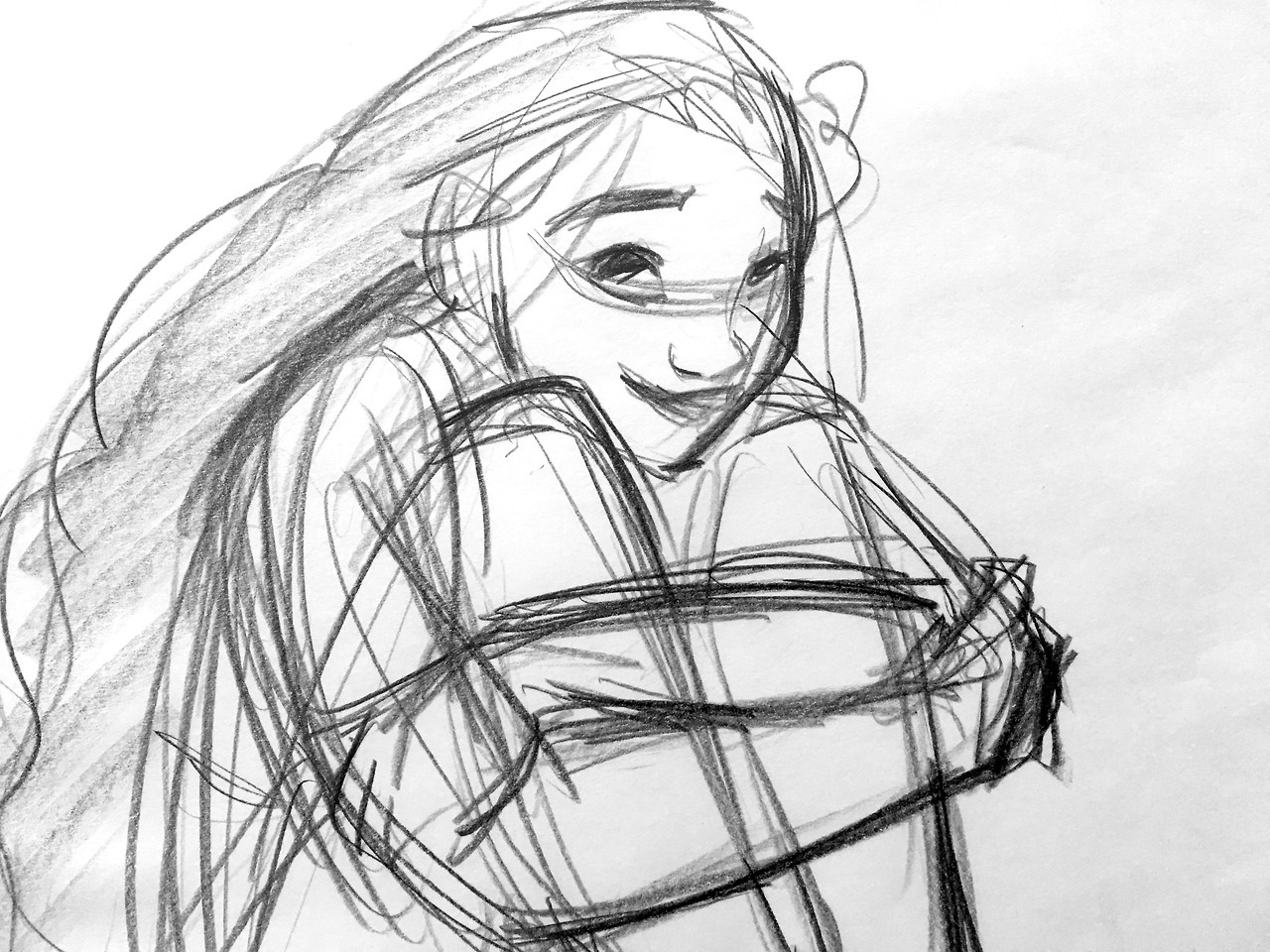
1.) The sketch was too imprecise. Your example is a good demonstration: there are a lot of lines for each line, and while looking at the sketch, our brain tends to automatically correct those and only see what we want to see, but when you have to ink, you have to decide which of the lines is “it” but might in the moment go for the wrong one, so that way you can and up with a sketch you like but a lineart you don’t like as much. For my skill level, that means more precise sketches. Better artists can probably get away with loser sketches.
2.) I’m a too careful and precise with my inking, leading to lines that are bland and timid. One thing that helped a lot are the drawabox.com exercises. (The instructions insist on doing them traditionally, but I used an equivalent digital brush, no stabilizer and no undo, and that helped me a lot with digital inking. YMMV.) I also picked up urban sketching a while ago, something along the lines of this, where you work deliberately fast, scribbly, without or with only minimal under sketch, and often with only a few continuous lines — and that also seems to slowly help with my “proper” inking. Either of these can also work as warmups.
But honestly, I think inking is one of the hardest parts. (Unless your lineart turned out well and you ruing it with colors. )
Yeah, at least what I saw from (traditional) Manga artists so far, for most, that sketch would indeed be too rough to ink directly, they’d first draw a clean sketch, and even if that sketch is not super precise they would just adjust the outlines spontaneously while inking, but with so many/so broad lines, it’s much harder to come up with a nice outline.
You need to be really confident to ink it like that directly, something you can probably do when you’ve drawn that character or at least characters in that style plenty of times, but otherwise, the result is just not predictable, I’d say.
But as said, with digital art, nothing bad can happen if you try anyway.
If the lines end up too messy, you can still decide to use it as cleaned up sketch for the final inking, or just try again.
I personally am still putting quite a lot of time into a prceise sketch, but the more I have in idea about the final outline, the more I can do spontaneously, and also have more experience which corrections can still be done even after you started coloring (often enough something looks odd after laying down some base colors and think about shadows/volumes), so my sketches natuarlly become less precise, but still far from that messy as the example above.
From casual observation, myself more from western comics or animation, there are two ways inking could be done. Maybe more, but boils down to two: ink directly on top of the very paper you drew on (the sketch be it rough or more clean in some kind of pencil. Sometimes non photo blue though regular graphite is common) and use ink to cover it up. Or use a lightbox to ink on a fresh sheet of paper. No rules only tools, I understand that, but it for me right now is much scarier to do it directly on the sketch you penciled in. Because what if I sketched in the initial penciling too dark and it cannot be erased and would ruin it adding additional line depth? Stuff like that for at least right now. I guess it will go away with practice, hopefully.
For digital the best solution is to create more roughs, getting more precise each time. I would say it’s pretty normal to have 3 rough stages before inking / lineart. Depending on how loose the rough is, and your experience, it probably will go down to just 1 rough eventually.
Would it really be fair or accurate to say that inking is a completely different beast than penciling or sketching. Regardless if inking on top of a sketch, for animation, comics, manga, so on and so forth, you should absolutely be slower and more meticulous about your lines? I looked up videos of cel animation inking and comics as well, they were doing a completely different system from penciling or sketching with regular pen. Am I right or am I seeing this wrong?
Yep, that is 100% true!
I know from experience that real inking with liquid ink on materials such as paper or parchment is a completely different matter from drawing with pencils or charcoal on these materials, as well as the difference between sketching and clean execution of what you sketched beforehand, because I once learned this as a profession. Okay, it was technical drawing, because I trained as a technical draftsman in mechanical engineering, but the materials are identical.
And to address the next step, the difference between working with real media and working digitally, again it’s a big step.
But once you’ve learned how to use a medium properly, you mainly need to learn how to use the new materials when you switch over. In other words, you already have the basic skills of execution, now you need to learn how to adapt them to the new medium, get used to it.
Which can take different amounts of time, the biggest leap is from pencil to ink, which is hard for almost everyone.
You wouldn’t want to have heard the curses from my classmates and me during the switch to ink.
Yes, you should be slower and more meticulous about your lines when you’re just starting out with that medium and are not as comfortable with it yet. As you gain confidence by practicing, you will pick up a bit of speed. If you see other more established artists going faster, that’s because they’ve done such work a billion times already and so they’re very used to it.
It is as always, you just have to practice, practice, practice and, as a German saying goes, practice until you drop and then just a little bit more (until you stop falling over).
Yes, I can only say that mileage helps a lot. One day I noticed that I can draw very neat circles and I haven’t even been practicing that! It just happened naturally.
So just keep drawing what you like, keep looking for things to improve a little, and do whatever you can to have fun while drawing and not get discouraged.
And probably don’t worry about “practice” in strict sense of the word until you get a bit more advanced. Until then think of practice just as making more art
 )
)


