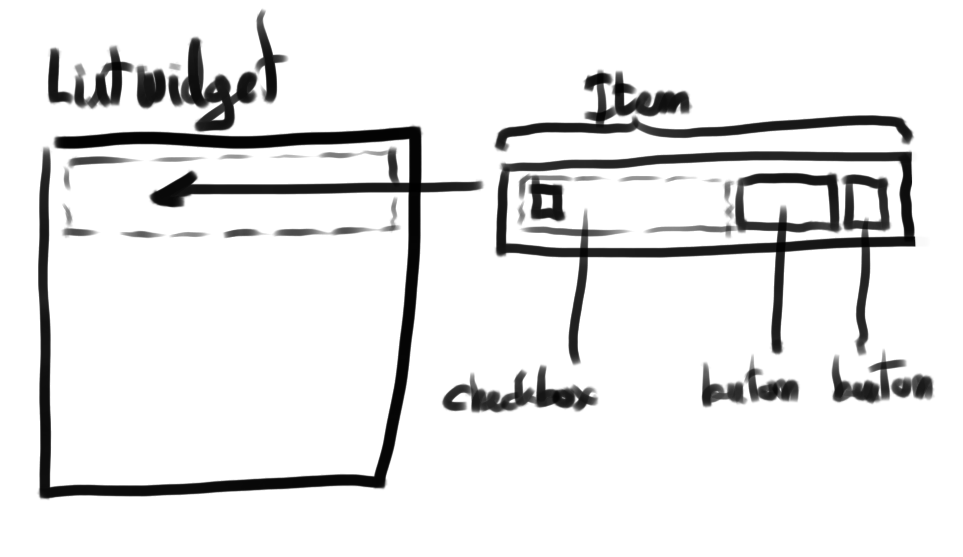
Little warning: QItemDelegate / QStyledItemDelegate goes deep to rabbit hole of Qt’s view / model / delegate programming. Here is small working example (tested on Kubuntu Krita5)
from dataclasses import (
        dataclass,)

from krita import (
        Krita,)

from PyQt5.QtCore import (
        Qt,
        pyqtSlot as QSlot,
        pyqtSignal as QSignal,
        pyqtProperty as QProperty,
        QEvent,
        QSize,
        QRect,
        QModelIndex,
        QAbstractListModel)

from PyQt5.QtGui import (
        QPainter,
        QKeySequence)

from PyQt5.QtWidgets import (
        QApplication,
        QStyle,
        QWidget,
        QHBoxLayout,
        QListView,
        QStyledItemDelegate,
        QStyleOptionViewItem,
        QStyleOptionButton,
        QStyleOptionToolButton,
        QCheckBox,
        QLineEdit,
        QToolButton)


@dataclass
class MyItem:
    checked: bool = True
    name: str = ''
    option_a: bool = False
    option_b: bool = False


class MyItemEditor(QWidget):
    value_changed = QSignal(MyItem)

    def __init__(self, **kwargs):
        self._enabled_check = QCheckBox(text='enabled')
        self._name_edit = QLineEdit(placeholderText='name...')
        self._option_a_button = QToolButton(text='A', checkable=True)
        self._option_b_button = QToolButton(text='B', checkable=True)
        super().__init__(**kwargs)
        layout = QHBoxLayout()
        layout.setContentsMargins(0, 0, 0, 0)
        layout.setSpacing(0)
        self.setLayout(layout)
        layout.addWidget(self._enabled_check)
        layout.addWidget(self._name_edit, stretch=100)
        layout.addWidget(self._option_a_button)
        layout.addWidget(self._option_b_button)
        self.setAutoFillBackground(True)

    def value(self):
        my_item = MyItem(
            self._enabled_check.isChecked(),
            self._name_edit.text(),
            self._option_a_button.isChecked(),
            self._option_b_button.isChecked())
        return my_item

    def set_value(self, new_value):
        if not isinstance(new_value, MyItem):
            raise TypeError('Value must be type of MyItem.')
        if new_value == self.value():
            return  # nothing to do
        self._enabled_check.setChecked(new_value.checked)
        self._name_edit.setText(new_value.name)
        self._option_a_button.setChecked(new_value.option_a)
        self._option_b_button.setChecked(new_value.option_b)
        self.value_changed.emit(self.value())

    # note: property is set to be "user" property, so that editor works with default
    # QStyledItemDelegate.setEditorData(...) and QStyledItemDelegate.setModelData(...)
    value_prop = QProperty(
            MyItem,
            fget=value,
            fset=set_value,
            user=True,
            notify=value_changed)

    def sizeHint(self):
        return QSize(200, 28)


class MyListModel(QAbstractListModel):
    def __init__(self, **kwargs):
        self._items = list()
        super().__init__(**kwargs)
        # populate model, with some test data
        self._items.extend([
                MyItem(name='my item 01'),
                MyItem(name='my item 02'),
                MyItem(name='my item 03'),
                MyItem(name='my item 04')])

    def rowCount(self, index=QModelIndex()):
        if index.isValid():
            # this model is strict list, tree indexing is NOT supported.
            return 0
        return len(self._items)

    def flags(self, index):
        return super().flags(index) | Qt.ItemIsEditable

    def data(self, index, role=Qt.DisplayRole):
        if index.isValid():
            if role == Qt.EditRole:
                return self._items[index.row()]
            if role == Qt.DisplayRole:
                # note: this is not used in MyItemDelegate(), but implemented for ease of use.
                my_item = self._items[index.row()]
                return f'{my_item.checked = } {my_item.name = } {my_item.option_a = } {my_item.option_b = }'
        return None

    def setData(self, index, new_value, role=Qt.EditRole):
        if index.isValid():
            if role == Qt.EditRole:
                self._items[index.row()] = new_value
                self.dataChanged.emit(index, index)
                return True
        return False

    def headerData(self, section, orientation, role=Qt.DisplayRole):
        if (section == 0) and (orientation == Qt.Hoorizontal) and (role == Qt.DisplayRole):
            return 'name'
        return None


class MyItemDelegate(QStyledItemDelegate):
    def paint(self, painter, option, index):
        my_item = index.data(role=Qt.EditRole)
        if isinstance(my_item, MyItem):
            self._draw_my_item(painter, option, index, my_item)
        else:
            super().paint(painter, option, index)

    def _rects(self, option, index):
        opt = QStyleOptionViewItem(option)
        self.initStyleOption(opt, index)
        rect = opt.rect
        height = rect.height()
        check_rect = QRect(rect)
        check_rect.setRight(rect.left() + 80)
        option_b_rect = QRect(rect)
        option_b_rect.setLeft(rect.right() - height)
        option_a_rect = QRect(rect)
        option_a_rect.setLeft(option_b_rect.left() - height)
        option_a_rect.setRight(option_b_rect.left())
        text_rect = QRect(rect)
        text_rect.setLeft(check_rect.right())
        text_rect.setRight(option_a_rect.left())
        return check_rect, text_rect, option_a_rect, option_b_rect

    def _draw_my_item(self, painter, option, index, my_item):
        widget = option.widget
        style = QApplication.style() if widget is None else widget.style()

        opt = QStyleOptionViewItem(option)
        self.initStyleOption(opt, index)
        check_rect, text_rect, option_a_rect, option_b_rect = self._rects(option, index)

        opt.text = my_item.name
        opt.rect = text_rect

        check_opt = QStyleOptionButton()
        check_opt.font = opt.font
        check_opt.displayAlignment = opt.displayAlignment
        check_opt.palette = opt.palette
        check_opt.direction = opt.direction
        check_opt.fontMetrics = opt.fontMetrics
        check_opt.text = 'enabled'
        check_opt.rect = check_rect
        check_opt.state = opt.state
        check_opt.state |= QStyle.State_On if my_item.checked else QStyle.State_Off

        button_a_opt = QStyleOptionToolButton()
        button_a_opt.font = opt.font
        button_a_opt.displayAlignment = opt.displayAlignment
        button_a_opt.palette = opt.palette
        button_a_opt.direction = opt.direction
        button_a_opt.fontMetrics = opt.fontMetrics
        button_a_opt.subControls = QStyle.SC_ToolButton
        button_a_opt.activeSubControls = QStyle.SC_None
        button_a_opt.text = 'A'
        button_a_opt.rect = option_a_rect
        button_a_opt.state = opt.state & QStyle.State_Enabled
        if my_item.option_a:
            button_a_opt.state |= QStyle.State_On | QStyle.State_Sunken
        else:
            button_a_opt.state |= QStyle.State_Off | QStyle.State_Raised

        button_b_opt = QStyleOptionToolButton()
        button_b_opt.font = opt.font
        button_b_opt.displayAlignment = opt.displayAlignment
        button_b_opt.palette = opt.palette
        button_b_opt.direction = opt.direction
        button_b_opt.fontMetrics = opt.fontMetrics
        button_b_opt.subControls = QStyle.SC_ToolButton
        button_b_opt.activeSubControls = QStyle.SC_None
        button_b_opt.text = 'B'
        button_b_opt.rect = option_b_rect
        button_b_opt.state = opt.state & QStyle.State_Enabled
        if my_item.option_b:
            button_b_opt.state |= QStyle.State_On | QStyle.State_Sunken
        else:
            button_b_opt.state |= QStyle.State_Off | QStyle.State_Raised

        style.drawControl(QStyle.CE_CheckBox, check_opt, painter, widget)
        style.drawItemText(painter, opt.rect, opt.displayAlignment, opt.palette, opt.state, opt.text)
        style.drawComplexControl(QStyle.CC_ToolButton, button_a_opt, painter, widget)
        style.drawComplexControl(QStyle.CC_ToolButton, button_b_opt, painter, widget)

    def createEditor(self, parent, option, index):
        my_item = index.data(role=Qt.EditRole)
        if isinstance(my_item, MyItem):
            return MyItemEditor(parent=parent)
        return super().createEditor(parent, option, index)

    def setModelData(self, editor, model, index):
        if isinstance(editor, MyItemEditor):
            # fix to bug in PyQt5, (failed to convert MyItem() -> PyQt_PyObject ???)
            model.setData(index, editor.value(), role=Qt.EditRole)
        else:
            super().setModelData(editor, model, index)

    def sizeHint(self, option, index):
        return QSize(200, 28)

    def editorEvent(self, event, model, option, index):
        if event.type() in {QEvent.MouseMove, QEvent.MouseButtonPress, QEvent.MouseButtonRelease}:
            my_item = index.data(role=Qt.EditRole)
            if isinstance(my_item, MyItem):
                pos = event.pos()
                check_rect, text_rect, option_a_rect, option_b_rect = self._rects(option, index)
                if check_rect.contains(pos):
                    print(f'Debug: editorEvent in check enabled rect {event = }, {my_item = }')
                    if event.type() == QEvent.MouseButtonRelease:
                        # toggle on release (should also check that press was done at same area.)
                        my_item.checked = not my_item.checked
                        model.setData(index, my_item, role=Qt.EditRole)
                elif text_rect.contains(pos):
                    print(f'Debug: editorEvent in text rect {event = }, {my_item = }')
                    # maybe add SelectedClicked to QAbstractItemView.setEditTriggers(
                    #       QAbstractItemView.DoubleClicked | QAbstractItemView.SelectedClicked | QAbstractItemView.EditKeyPressed)
                elif option_a_rect.contains(pos):
                    print(f'Debug: editorEvent in option_a rect {event = }, {my_item = }')
                    if event.type() == QEvent.MouseButtonRelease:
                        # toggle on release (should also check that press was done at same area.)
                        my_item.option_a = not my_item.option_a
                        model.setData(index, my_item, role=Qt.EditRole)
                elif option_b_rect.contains(pos):
                    print(f'Debug: editorEvent in option_b rect {event = }, {my_item = }')
                    if event.type() == QEvent.MouseButtonRelease:
                        # toggle on release (should also check that press was done at same area.)
                        my_item.option_b = not my_item.option_b
                        model.setData(index, my_item, role=Qt.EditRole)
        return super().editorEvent(event, model, option, index)

    # def updateEditorGeometry(self, editor, option, index):
    #     pass
    #
    # def setEditorData(self, editor, index):
    #     super().setEditorData(editor, index)


_keep_alive = None


def testing():
    global _keep_alive

    my_view = QListView()
    my_view.setModel(MyListModel(parent=my_view))
    my_view.setItemDelegate(MyItemDelegate(parent=my_view))

    my_view.show()
    _keep_alive = my_view


testing()
Have fun in this rabbit hole.
/AkiR