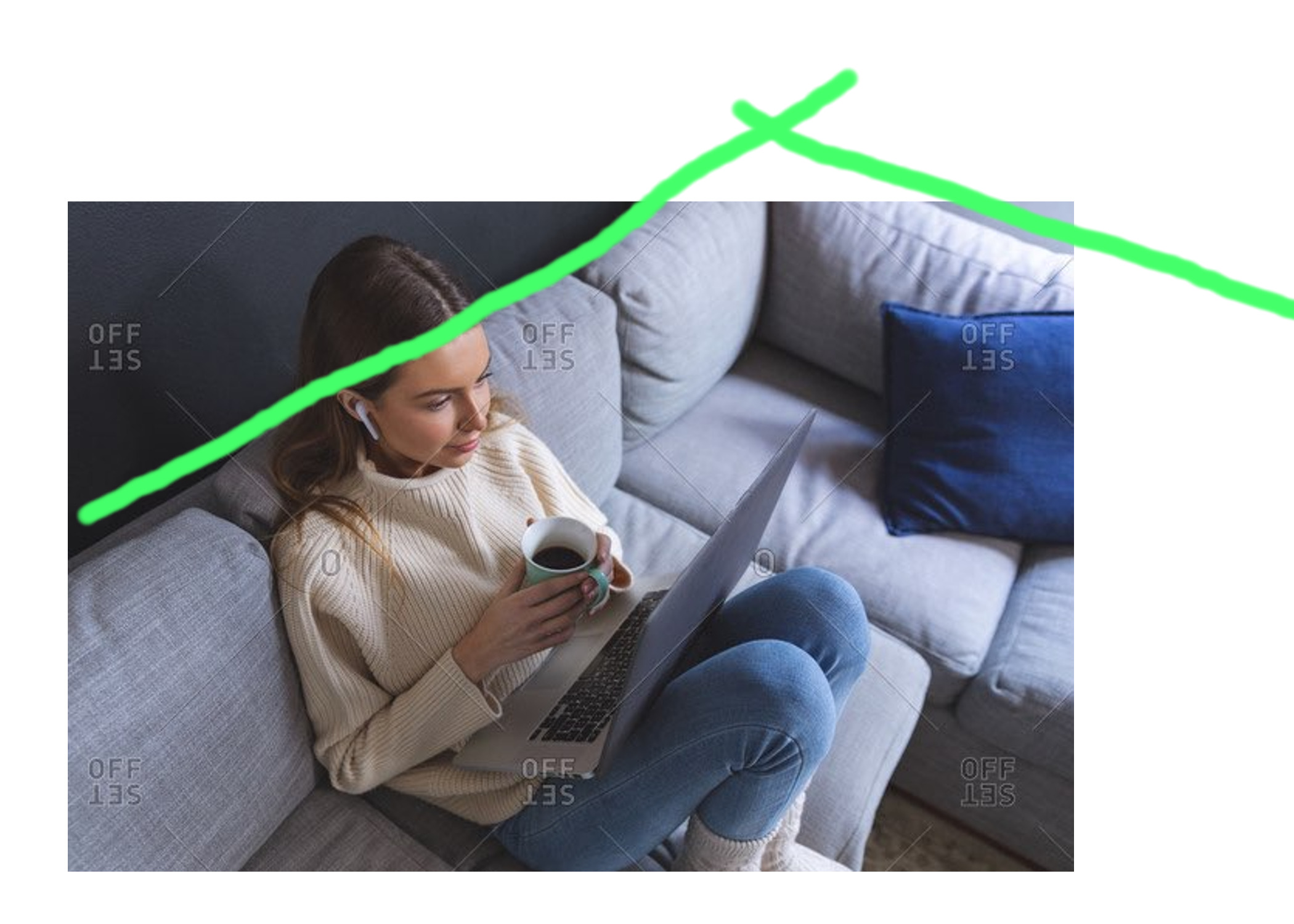
I somewhat understand what vanishing points are, where lines meet but for an image. However for a downward view of a couch, I am a tad lost. For an “L” shaped couch, would the vanishing points be the corner where the couch turns (or be hide it)? or would it be something else?
In simplest terms, vanishing points are the location that parallel lines would theoretically intersect. The green lines you drew actually coincide with 2 different vanishing points.
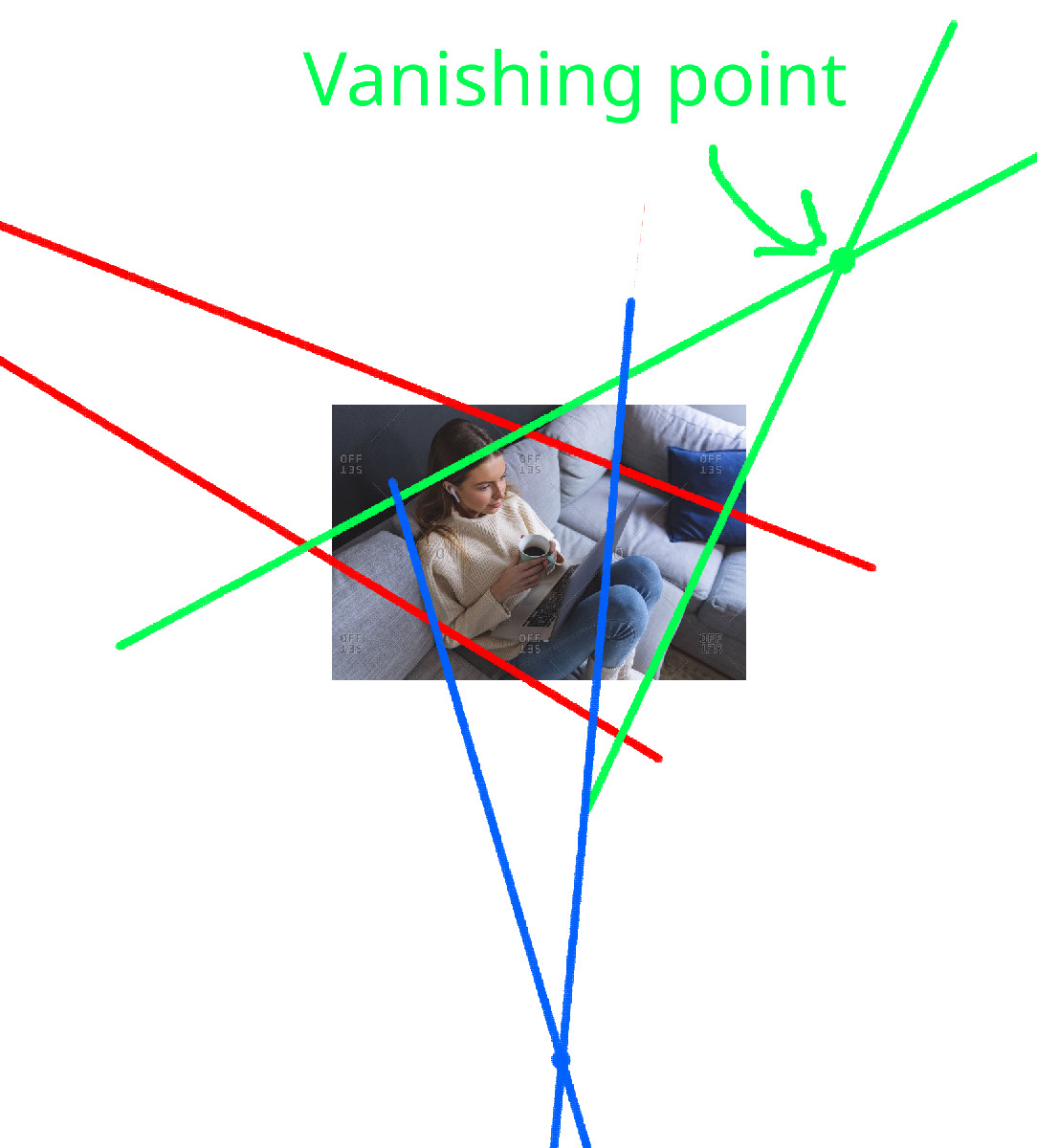
The 3 vanishing points in this image are somewhere around here:
As you can see, they can be very far away from your subject. The farther away they are, the higher the camera’s focal length.
Just remember that all vanishing point ray lines are perpendicular to each other, and all ray lines that belong to the same vanishing point are parallel to each other (in 3d space)
Alrighty thank you. So If I were to raise the camera angle up, so its more of a downward view, how would that effect the vanishing points? I can dm you the rough thumbnail sketch I made if you are fine with that
As you tilt the camera down, the z-axis vanishing point (blue) will get closer to the center of your screen, and the two horizon vanishing points will get farther away, exponentially. If the camera is pointed straight down, the z axis will be directly in the center of the screen, and the x/y green/red lines vanishing points will be infinitely far away.
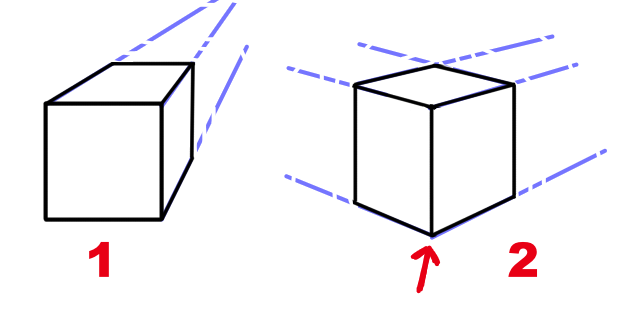
“Object lines” is different from “horizon line”. In perspective there are three basic situations: the object is above(1) the horizon line (A) ; the object is in front of the line (2) or it is below it (3).
In the case of the photo you posted, the situation is similar to 3… and there are also 3 vanishing points, as Ralek showed…and in my example there is only one vanishing point (arrow).
how can i tell how many vanishing points there are? I know where parallel lines go but how is there 3 in that example? I only see one set of parallel lines
@Guerreiro64 wrote its “similar” in their one point perspective. You get more vanishing Points for every axis that isn’t parallel or perpendicular to the horizon line.
If you would rotate the objects around the z-axis you get another vanishing point, rotate it around the y-axis too and you get a third one.
Perspective is unfortunately an extremely complicated topic. You can break it down like @Guerreiro64 did, but in the end you’re going to have to learn a wide range of scenarios.
All artwork that’s supposed to depict our 3d universe have between 0 and 6 vanishing points. Up to 2 for each dimension. In his example specifically, there is 1.
As for how to tell how many, that’s rather complicated, but it’s basically this:
Extend 2 parallel lines outward, 2 for each axis.
If the lines never converge, that’s 0.
If the lines converge, that’s 1.
If the lines are bent, that’s 2.
Add up all 3 pairs of parallel lines and you get the number of vanishing points.
In the real world the answer is always 3 or 6. But art doesn’t need to follow that.
If that’s confusing, that’s fine. People go to college for this stuff.
In one of the videos I posted, the author shows why an artist used three vanishing points instead of two…
These videos, of course, are not going to be enough to teach you everything about perspective. There is also this tutorial… and at the end of it, the author indicates more links.
I’m, uhh, not sure that it’s true. For a picture of a cube - yes, I think, but for a more complex picture you can have an infinite number of vanishing pounts, I believe.
Imagine a stack of books arranged in away that they create a sort of a spiral, like DNA (every book laying on top of the previous one but rotated a little bit). Even when creating an artwork of this stack of books in a standars 2 point perspective style picture (all vertical lines in the world are straight and parallel on paper), you get twice as many vanishing points as you have books. All of those vanishing points are on the horizon, but they are different points. If you then add the possibility of books laying not completely horizontally but at an angle, which gives you vanishing points belonging to different horizons, it really gets more and more complicated.
Usually when you draw a picture with perspective, you don’t really need all that (unless you draw a messy room with stufflike tables and chairs in disarray, not neatly parallel or perpendicular to the walls), but when trying to figure out perspective from photos (even those with little to no lens distortion), it might be important to not get even more confused when the reality doesn’t seem to match the theory.
@EggButSquare it seems like the most useful bit of knowledge you should learn is that:
every two parallel line in real life should lead to the same vanishing point
every two rectangular planes (for example, every two pieces of paper) that are parallel (for example opposing walls, or the surface of two different tables) should make vanishing points that belong to the same horizon (all vanishing points from lines on those planes should belong to the same line)
Correct! A cube in space can have 1, 2 or 3 vanishing points. It may help to think of directions instead of parallels - each set of parallel lines has the same direction, and each direction has its own vanishing point. There can be an infinite number of directions in 3D-space. A single object could have up to as many vanishing points as it has edges.
In art tutorials, perspective is often taught by using the special cases (1pp, 2pp, 3pp), which can lead to confusion, when arbitrary situations are examined. To really understand perspective, one should think of projections: it’s always a projection through the viewing point onto a plane that is perpendicular to the viewing direction. There’s a reason though, why we start with the special cases, and that is because proper construction of the arbitrary cases can get quite complicated quick.
That’s true for rectilinear perspective ! Once you start working in curvilinear - aka spherical or fisheye - perspective, you can represent higher FOVs and indeed end up with more vanishing points for a cube. A regular cube, mind you - if it’s a hypercube, then
Well, yeah! But that’s for nerds j/k… I guess, once you go beyond rectilinear, it’s easier to draw it intuitively until it looks right - or use 3D software.
Ah yes thats not true now that I look at it again (I actually had a part in there I must have erased about imagining a cube and dividing up the lines into parallel groups). All parallel lines have 0, 1, or 2 vanishing points and you can have an infinite number of directions for parallel lines thus infinite vanishing points, my bad @EggButSquare
2 vanishing points is for curvilinear space, or in this case fisheye perspective. Parallel lines converge on 2 points 180° from each other in physical space.
If your field of view is greater than 180°, your drawing must be in curvilinear space. This is where we get 6 point perspective


 j/k… I guess, once you go beyond rectilinear, it’s easier to draw it intuitively until it looks right - or use 3D software.