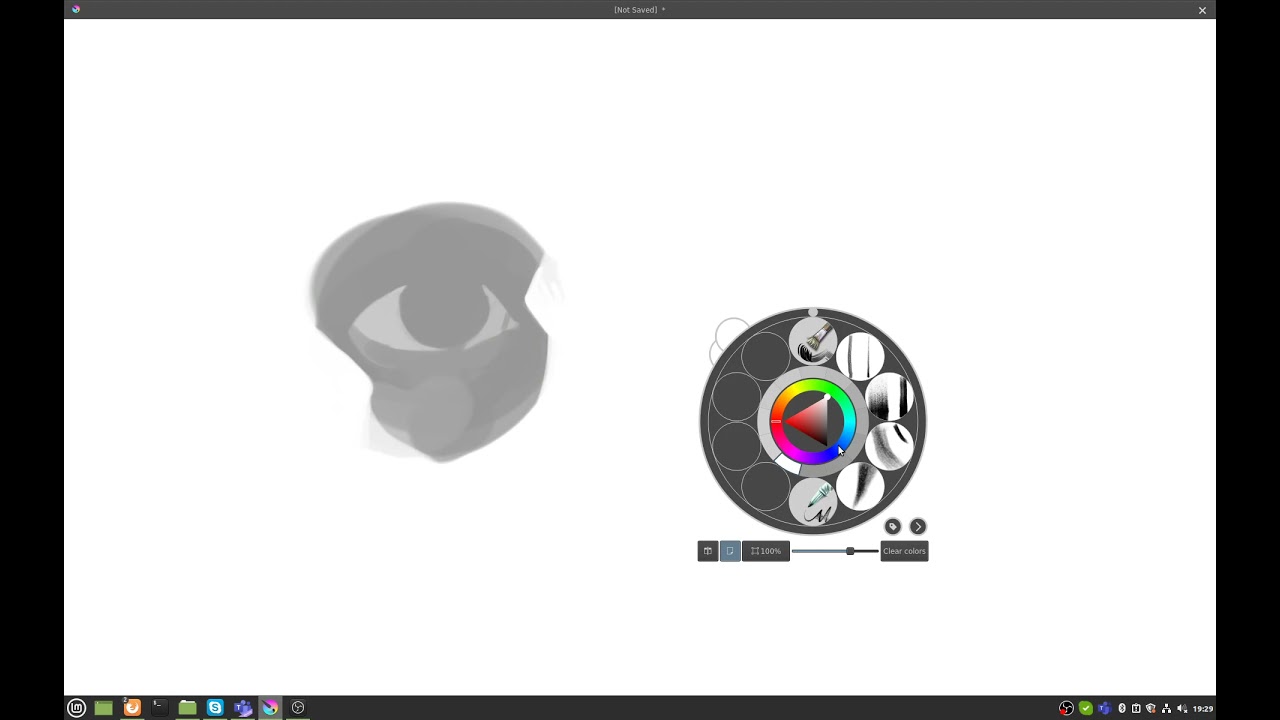
So here’s something I’m almost too embarrassed to post. I still struggle with the basic issue of how to paint shapes that don’t naturally come from the selected brush shape. For example, the basic round tip and sharp points.
Here’s a short demonstration of a very stylized eye. I first paint with a round brush, and you notice I run into the issue that when I need to e.g. redo the outline of the iris, I have to either just repaint the lid or try to go in and get that sharp corner with a small brush. The second version is what I’ve ended up doing, namely buying a pen that has rotation support, which lets me use squished brushes and have fine control over the orientation. Even this isn’t perfect, but it’s better.
Now this example is basically just a two-tone silhouette, so either way will get you there. But things get more complex when you start rendering in more detail, so that I find myself spending much more time than I’d like massaging the ends of my strokes, repainting areas over and over to keep a sharp silhouette.
How do you approach this? I know some people use layers to first design the important silhouettes of their painting, then lock the layer transparency and paint within that shape. I’m not a fan personally, it feels cumbersome to me and I tend to get a look I don’t really care for.
It kinda sound like you have already found a solution. Just remembering to keep certain edges without over blending. Is this what you mean?
I can relate to this but what can help is having a rough sketch of your painting before you start to help you define your edges early and remind you later on.
Otherwise it is basically keeping in check that you don’t over blend and smudge everything into one. Be decisive about your edges and blends, this will obviously also be impacted by your style. Sometimes you do end up smudging old defined lines but I find it is sometimes the process of finding the painting within the painting. Painting like a skulptor in a sense.
I’ll also add that using smudge engine brushes speeds up my painting process as you can easily lay down an edge and then smudge one side of it. Like creating a sharp edge with a gradient “fold”
I mostly use flat brushes, and until last year was only using the drawing angle for rotation.
Now I use both that and the tilt direction settings. Tilt is better for more natural dynamic control; enabling the use of different edges of the same tip. Drawing angle is easier though if you’re doing circualr movements - so probably better for paining the circular parts of the eye.