Hello all! I have being using Krita almost 6~7 months and honestly?
I love it! But there are some hiccups in my workflow, 'cause…
(Attention: this is going to sound very, very basic!)
I am overwhelmed by the number of brushes. Look, I don’t know which one to use! I generally go with a more traditional approach: sketch, inking and then shading.
Could I ask you guys to share which brushes do you guys use in your workflow?
Oh boy… Probably every user here could write an essay on their brushes I can share what I use, but it could be more helpful if you shared what are you concerns or these hiccups that you worry about? Maybe then we can suggest a solution.
As for my brushes, I typically work with these:
sketching or roughs - h) Charcoal Pencil Thin - c1) Pencil H Sketch - deevad 23.01
Generally, only at thick painting / rendering stage I start jumping between many brushes. When I do sketches, linearts, or flats, I use a very limited set.
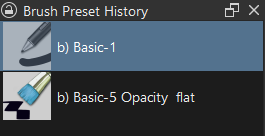
Of course also the eraser (or eraser mode brush) and flat hard bursh such as “b) Basic-1”.
I know you want a different answer, but the answer you want can tell you (great) brushes that don’t suit you! So, don’t hate me for my answer, I truly mean well!
All you have to do is sit down and try out the brushes one by one. Make a note of the ones you like and whose behavior suits you, along with the reason why you like them, so that you can choose the ones you would like to use most in another session, if necessary.
And, before you begin your tests, don’t forget to activate the “Krita_3_Default_Resources.bundle” via ‘‘Settings’’ >> ‘‘Manage Resource Libraries…’’ first, as it contains some other fantastic brushes.
I understand the dilemma. My workflow now is to stick with one or two brushes for an entire painting – usually one in sketching size and one large. By the end of the piece, I know what I like and don’t like about the brushes. Even though I know I don’t need many, I still get excited each time I see a new brush set to download.
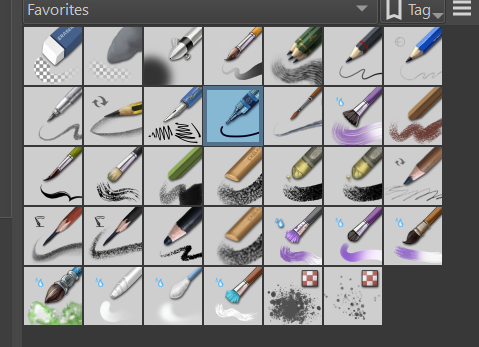
Tips: When you find your favourite brushes, tag them as Favourites and only have the Favourites brush set shown in the docker. That is a good and simple way of limiting the huge amount of brushes to a few ones you use most often.
Regarding your request for help with paintbrushes, I have just thought of a visual comparison, which has nothing to do with paintbrushes, but should make clear what I was trying to say above.
Imagine if a person of very small stature, with thin arms, had asked me, in my prime, two meters tall and with arms stronger than most people’s legs, for my favorite sledgehammer, I suspect that the person would not be happy with it.
Now, unfortunately, there are far more different brushes than there are hammer variants, so you’re going to have to test for longer, for better or worse.
Please excuse me, but I’m not going to satisfy your impatience in this regard, besides, you could already be trying out brushes instead of waiting to be recommended one or more brushes that in the worst case limit your creativity.
The right brush will not turn you into someone who can paint great pictures, only practice can help you achieve this. But it would be a waste of time to get annoyed with my or other users’ favorite brushes in the belief that you too could paint great pictures with them. This only works with the brushes that you have “acquired” by trying them out. As sorry as I am, there are no shortcuts on this path, this is a fallacy of many beginners.
And I will not help you to fail at the beginning!
Michelist, it is not a question of impatience, but more as not knowing exactly. I do believe that, in the beginning, it helps a lot to imitate, others, more established illustrators. Yes, I understand that the tool is not what will make someone a good artist, although it does help, and I understand you emphasis in trying them out.
Of course, if you prefer not share, no problem, I won’t bother you with that.
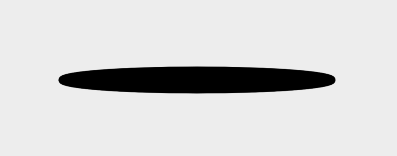
my work horses, probably 80-90% of most of my stuff is done with these! The second one is just the Basic 5 Opacity with that brush tip. I vary everything else to a desired look, as my stuff is usually more abstract. Even my blending/ smudging varies on what I think looks good.
But to imitate others, you have to paint! You are as thousands of beginners all around the world, believing that the brush is the important thing, believing “if I got brush XYZ artist ABC uses, I can paint the picture’s artist ABC paints”, without recognizing that you have to copy the pictures of artist ABC with as many brushes as its need to find that brush / those brushes that enables you to paint the way the artist you copy paints. Usually this will not work today or tomorrow, but soon you acquire a few brushes that/those enable you to paint nearly everything. In the beginning, these pictures may not come out as you want them to come out, so what? Do it again, as every great artist did in the break of dawn of its career. And again, and again. This was the like hundreds of years before us, and it will be the like in a hundred years (if they don’t make optimized Android’s out of us, that will learn faster than we can).
The longer we discuss it, the more time you waste discovering the brushes that you feel do what you want them to do best, the brushes that “obey” you, and begin your journey into the world of copying others and painting your own.
really all the different pencils, paint and ink brushes don’t matter if you don’t see it on the finished product. I have tons of brushes for landscape that came with packs. I don’t use them presently, but there could be that day a leave or a tree looks good in a abstract.
I just use what I’m feeling up to doing at the moment (and then I forget what I used after putting my project down for a few weeks, lol).
I mostly start with either a pencil brush or a ballpoint pen (which I would do in real life). Then I use any brush I’m in the mood for to fill it in (watercolor, pencil, crayon, thick oils, acrylic, etc). Just take a look at my gallery here. Most of the time, I list what brushes I used.
I agree with what @Michelist is saying, but I have one thought worth considering.
When I was starting out (around 2 years ago), I was really anxious and unsure about things. I was often having such thoughts:
am I bad, or is my tablet low quality?
will I paint better if I buy an expensive, high-end device?
is my painting program too limiting, or do I not know how to use it properly?
should I draw this or that?
etc. this list would go on and on.
Now with the experience I gained, I can say that 90% of the time it’s the artist and their (my) lack of ability No external factor such as the tool, the program, the brush will make or break your art, it is just you and your skill.
But consider this now: knowing in detail how a better artist created their painting - the tablet, the brushes, the process - can be liberating and motivating. If you have the same tools at your disposal and yet somehow you can’t create as good a work, then it means you only need to bridge the skill gap. There’s nothing limiting you from achieving the same, just the dedication and the effort required.
I don’t know about you, but for me knowing this is somehow reassuring.

 I can share what I use, but it could be more helpful if you shared what are you concerns or these hiccups that you worry about? Maybe then we can suggest a solution.
 - h) Charcoal Pencil Thin
 - c1) Pencil H Sketch - deevad 23.01
 - d) Ink-4 Pen Rough
 - inkP 02 Worn Out GPen
 No external factor such as the tool, the program, the brush will make or break your art, it is just you and your skill.
 need to bridge the skill gap. There’s nothing limiting you from achieving the same, just the dedication and the effort required.