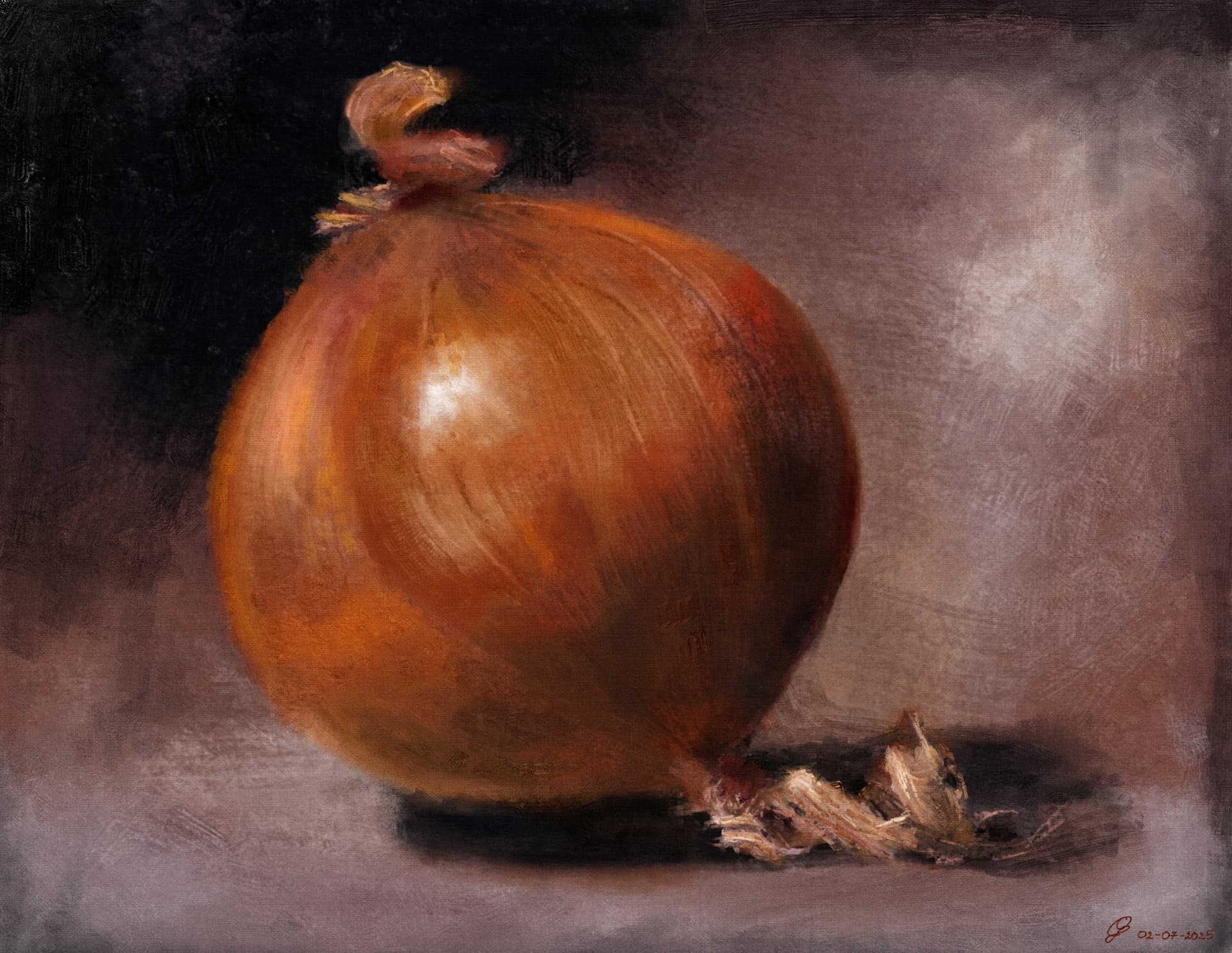
I could work on it more, but it was done mostly to destress from many practice of drawing humans. It is refreshing to take care of simple still life for less than two hours.
46 Likes
I understand the stress - and destress  . But that aside, this is a fantastic, a realistic master artist presentation. I’m sure many people, including myself, had such skill as this.
1 Like
I apologize for my last post. I meant to say that myself, along with others, whished we had your skill.
2 Likes
Wow. This onion painting is so good I can feel it and hear it. It’s a really impressive still life!
1 Like
Just so you know; I, at my skill level, still have moments: “can I really paint/draw or did I just get lucky a few times”. It’s a bit like me solving a Rubik’s Cube – I can do it fast because I’ve memorized the instructions, but I can’t do it slowly because I remember them physically, rather than mentally. I don’t think I could teach it to anyone else. My ability to do it depends a lot on how I feel.
If I can give any advice, I recommend using a palette with just dozens of shades of color and values instead of a whole color wheel with its millions of combinations. A color wheel trains the eye and hand, but mind only a little bit. The color palette can be remembered more easily and therefore understood more easily.
Think of a dual skill set of art; fast and slow (or hot and cold). The former is personified by the Ostrich, and the latter by the heavy draft horse of the Schire breed. Ostriches can run at speeds of up to 70 km per hour, while Schire horses can run at 30 to 35 km per hour. The intuitive “hot” fast painting mode can quickly produce an impressive effect and certainly many artists have only thought of it as proper art. The problem is: that many of them often fell into depression when, due to health processes or personal circumstances, they did not achieve the proficiency they once had. The Ostrich can be ridden, but it is unpredictable, naturally distrustful, even a domesticated one is difficult to rely on.
The slow mode is knowledge and “cold” understanding, the artist can be dying slowly of old age, be half blind and still able to create (e.g. Jan Matejko, due to his visual impairment, was never able to see his greatest work “The Battle of Grunwald” in its entirety, but he worked piece by piece for years). It provides less intense pleasure, but you can rely on it like a friendly horse of the Schire breed, which has been trained over generations to be reliable.
There is nothing wrong with riding the Ostrich from time to time to feel the speed, but the main focus should be on the Horse. Because of its reliability, slower horse may get you faster to your goal than faster Ostrich, because a horse is mostly obedient, except under the quite unfavourable conditions, and Ostrich is obedient almost exclusively under the best conditions. Furthermore, in the worst conditions a horse will usually simply collapse from exhaustion and stay in place, whereas an Ostrich can lead you even further from your goal and dump you in a lake of artistic bitterness and despair.
2 Likes
I love the texture on this. What brush did you use?
2 Likes
Mainly “memileo 360light flat brush”. I have to add though, that I have made a few variations of this particular brush. First, I set the pressure sensitivity to a normal 45 degree curve for all. You may prefer a different one, but you can try it. Second, I turn off the “value” in the brush settings because I find that it causes slight variations in the shades, but again, it’s not that important.
What’s more important is that in the brush tip menu I turn up the contrast to up to 100% [check out “Master The Memileo Brush Bundle in Krita Like a Pro” on official Krita Channel where Ramón tells how to paint gold]. This gives the impression of a metallic paint. With a strong pressure, the metallic shine is obvious, but with a medium or light pressure, the impression of metal disappears and the brush strokes themselves have more depth to them. Also, the next variation is the same metallic brush, but with the “RGBA anim 01” tip that I use for small details (those roots of an onion for eample). Another variation is to change the tip to “scrathes_rough” or to “DA_RGBA bluegreen_small”, which gives a brush that is less “wet” and more “hair-like” but retains some of the smudging properties of the memileo brushes. Another variation is to simply change the brush tip to “memileo_360light-PHOTO-E_03-random” and increase the spacing to around 0.77, which gives the impression of using the brush multiple times rather than a single, simultaneous stroke.
3 Likes
Neat!
1 Like
Hey, this is a nice one ! welldone for the color,lighting and shadows, and brushworks are pretty smooth though, love it
1 Like