Hey thank you for this great Krita software.
I love the feature + painting a pattern in repeat - square repeat. Can we have the option of switching between square repeat mode to half drop mode?
Hi @GeneBrown999 - Welcome to the community.
Perhaps others who know more about this feature will comment on ways to do this. If it turns out that it’s not possible in Krita, you could then write a feature request for it. Bear in mind that many of us won’t know what “half drop mode” is so you might want to add some more info.
The internet - it’s so useful  :
:
Hey . sure thank you for the reply. A half drop is basically used quite a bit in surface design patterns. In a program like krita and Photoshop I would describe the Wraparound mode as using a 50% horizontal offset. I will take your advice and post that in the “feature request” section.
thanks the heap
Here is a page from the manual to help you make a feature request: Developing Features — Krita Manual 5.2.0 documentation
@Guerreiro64 - “Half drop offset” means the tiled section of the canvas would shift to the side by 100% and shift down by 50% (offsetting the tile by half its height). So, where you would normally have a checkerboard when wrap is turned, you would instead have something that looked more like a brick wall (where each brick would sit over the two beneath it). See attached image for visual examples.
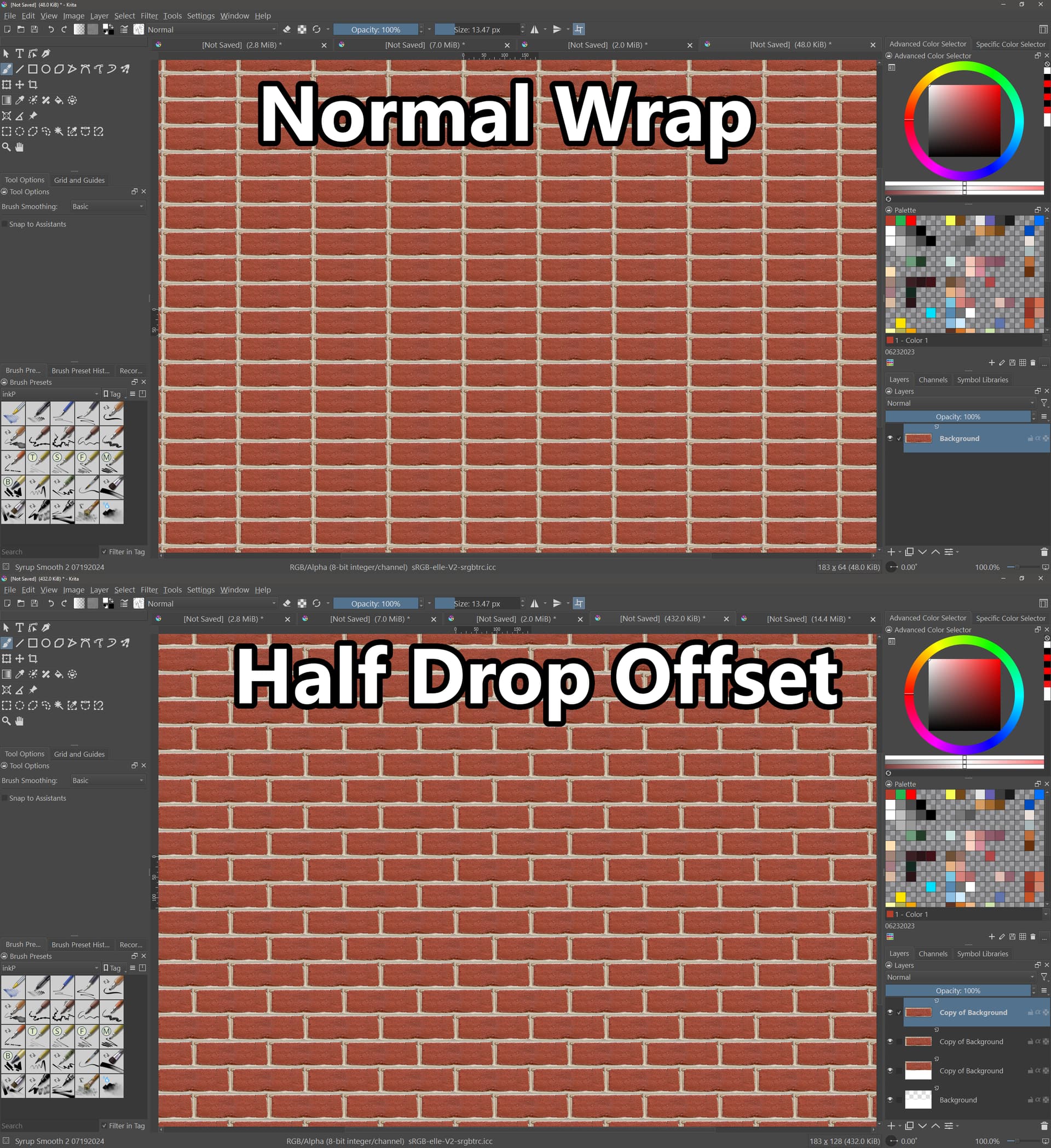
I see. Well, I never knew the technical name for it, I just called it an “interleaved pattern” (and the word interleaved is probably not accurate, depending on the language);
I do most of my patterns this way, because I find the normal way a bit boring. Here are some of them for free download.
@Someonesane In this video, David Revoy demonstrates how to make a brick wall in Krita. I don’t know if this will be helpful to you (maybe the brick wall is not specifically what you want to create) but something in his technique may prove helpful.
Thanks @sooz. Though, for thread clarity, I’ll just mention I’m not OP of the thread with the question. I was just explaining what the term meant, and showing that it could be done in Krita, though it’s not as simple as having a function that automates it for us, unfortunately.