I was just reading Björn Ottosson’s article. In it there is a summary of the various models and two new models are proposed:
| HSV | HSL | HSLuv | Lab-like* | NCS | Okhsv | Okhsl | |
|---|---|---|---|---|---|---|---|
| Orthogonal Lightness | no | no | yes | yes | no | no | yes |
| Orthogonal Chroma | no | no | no | yes | partial | no | no |
| Orthogonal Saturation | partial | no | no | no** | no | partial | no |
| Orthogonal Hue | partial | partial | partial | yes | yes | yes | yes |
| Simple Geometrical Shape | yes | yes | yes | no | no*** | yes | yes |
| Max Chroma at Edge | yes | no | no | yes | no | yes | no |
| Varies Smoothly | yes | yes | no | yes | yes | yes | yes |
| Varies Evenly | no | no | no | yes | partial | no | no |
We can see that “Lab-like” has the most “yes”. One of its shortcomings is “Orthogonal Saturation” which is not well done by other models. The other is Simple Geometrical Shape:

LCH has a dynamic color picker. But it tends to be triangular, which is an advantage: it is always “low saturation” in areas close to white and black. However, the current three-level color selector is only the HSL model.
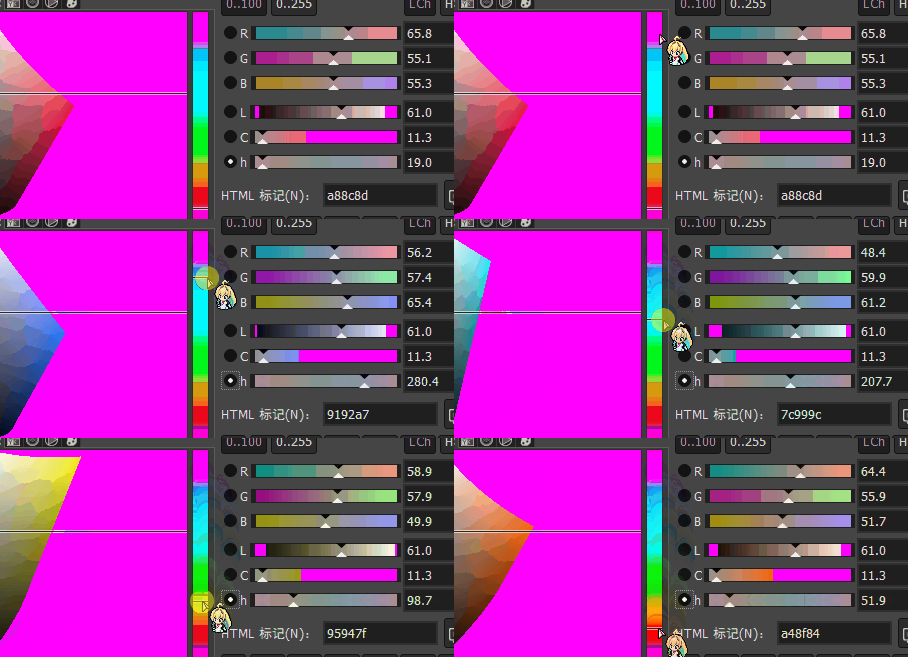
GIMP also has an LCH color picker. It may be made by cielab, so the hue is a bit strange. The LCH produced by Oklab is more ideal. It is said that photoshop2022’s new update on gradients uses oklab